Sunday, 27 March 2016

Adonis Blue male

A stunning little butterfly of chalk land habitat and is becoming quite scarce compared to a few years ago. They are doubled brooded, flying about the 2nd week of May to the end of June,  and again from early August to the end of September. It prefers herb rich grassland on south facing hills. The  females lay their ovum on the undersides of Horseshoe Vetch leaves.
The males being very distinctive with their bright blue upper wings while the colours of the wing undersides
can vary
2nd brood Male wing undersides 
1st brood male wing undersides

Friday, 18 March 2016

Small Heath

This beautiful little insect is one of our commoner grassland butterflies. And is found in a selection of habitats, including grass verges, meadows, woodland rides and clearings, etc But not so often seen, as they tend to fly low down in amongst the vegetation, and always rest with their wings closed. The female is larger and paler in colour than the male.


Female Small Heath
The smaller male where you would normally find them, down in amongst the vegetation
There are 2-3 broods a year, depending on how far south or north they are, with the ovum being laid on various meadow grasses, Fescues and Bents. In the summer the transformation from egg to butterfly takes about 8-9 weeks. They also overwinter as a larva.

Sunday, 13 March 2016

Butterflies copulating overnight

Small Tortoiseshells were believed to be the only British species of butterfly that copulated overnight. Well new evidence has proved otherwise. On 29th April 2014 i found a pair of mating Orange-tips close to my home at about 5pm and they were still joined the following morning at 7am. Meaning they had been joined for at least 14 hours and, maybe a possible two more hours [my thinking is that they only parted when it was warm enough] making it at least 16 hours of mating. I have since learnt that Nigel Kitely has photographed a copulating pair of Meadow Browns that were covered in dew, which he found early morning in some long grass. Which indicates that the Meadow Browns also copulated overnight.

This pair of Orange-tips mated overnight, just like the Small Tortoiseshells


I believe that this happens when butterflies mate/join late afternoon. The sun goes in, becoming cold, so they roost where they are and stay joined overnight. The following day they go their separate ways, once its warm enough. It is thought that mating saps the males energy, which is why males tend to take in salts/minerals from Horse droppings, damp soil etc., to build-up their energy levels. Mating for the average species of butterfly probably only lasts between 40-60min. So why mate all night? As this act could well prove to be fatal to the male butterfly. Both male and female Orange-tips flew off after their marathon copulation.

Unable to complete metamorphosis


A gene named Broad is found in caterpillars and, is essential for the change from larva to pupa to complete the metamorphosis. If a caterpillar is without this gene it is incapable of developing, and making the important change to a pupa. And, so fails in its quest to become a butterfly.

Reference, Scientific American, [for the information on the Broad Gene]. All photographs are the copyright of Nick Broomer

The 1st photo depicts a small White larva at 25mm in length, and 2-3mm wide. This is the normal size of a 4th instar larva that is ready to pupate.

A final instar Small White larva at 25mm in length and, ready to pupate

The 2nd photo depicts another 4th instar Small white larva that has grown to the enormous size of 35mm in length [10mm above the normal size for pupation for this species] and, 5mm wide. Far to big to pupate. If this larva had managed to complete its journey and become a butterfly, it probably would of been called a Large Small White. The reason for this abnormality is that this larva was missing that vital gene, the Broad gene and carried on eating until it died without developing any further and not being able to pupate.
A final instar Small White larva at 35mm in length, should only grow to 25mm in length
I n the 3rd photo [just for comparison] it depicts a Small White larva preparing to pupate, now only 19mm in length, the actual size of a fully pupated pupa, [bottom left of the photo]. Whilst in the top right of the photo, you have the overgrown larva at 35mm. Which is genetically incapable of pupating.

Two Small White final instar larva, the one on the left is ready to pupate
the one on the right has failed to pupate and carried on eating
and eventually dies
The 4th photo depicts a final instar White Admiral larva that is probably also missing the Broad gene. Instead of pupating at this stage of it's life, which it should of done, it just stayed on it's leaf without eating until it also died because it was unable to pupate.
Final instar White Admiral larva that failed to pupate


Tuesday, 8 March 2016

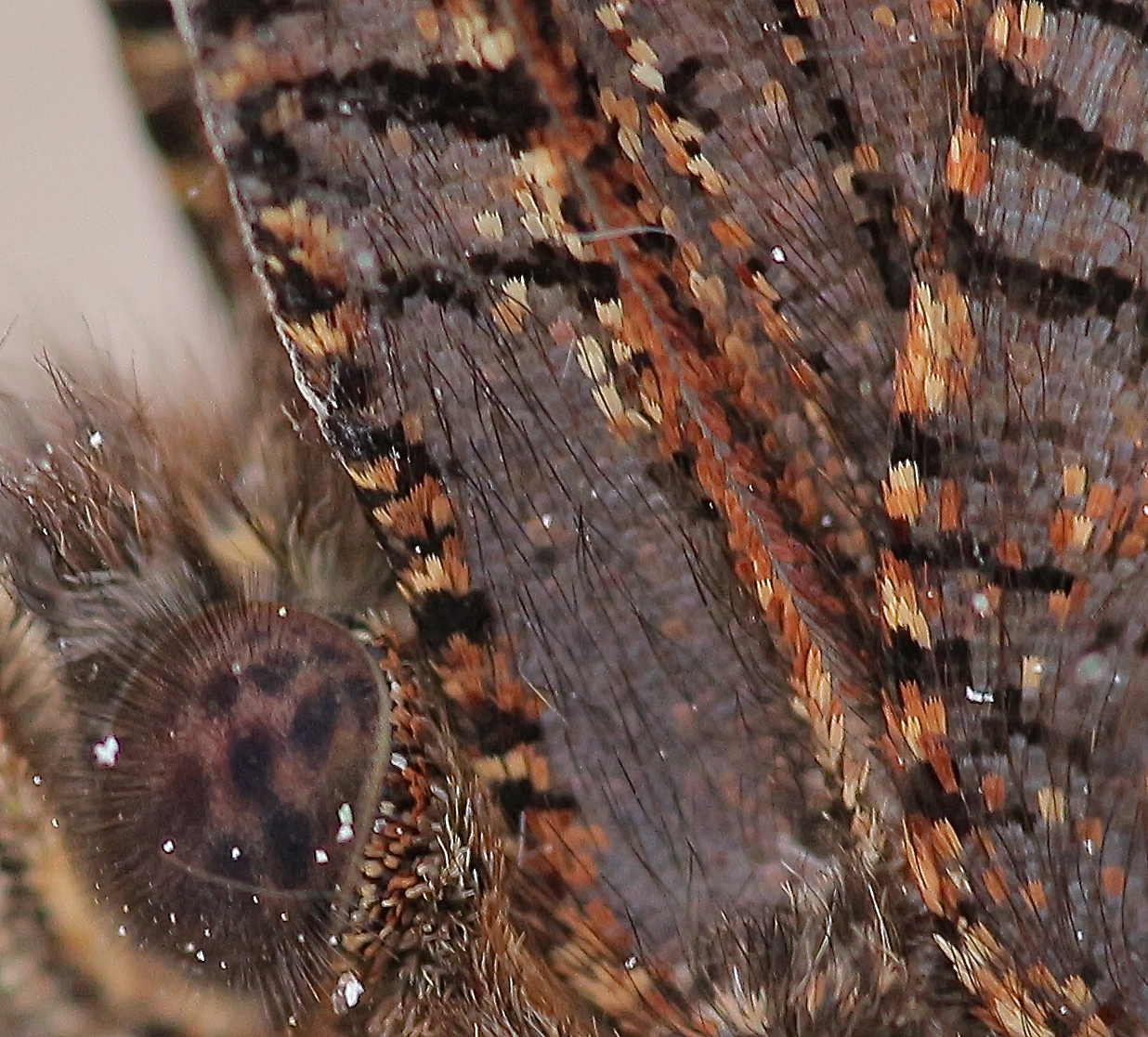
A closer look at the eye of a butterfly

Ultrastructure and adaption in the Rectina of Aglais Urticae, Ledidoptera. By, Springer. Also a big thank you, to Iris Scientist for pointing this out to me.

Some butterfly's eyes are covered in tiny hairs, known as Interfacial hairs. These hairs are believed to help orientate light which penetrates the butterfly's eye and, so are expected to perform like that of Corneal Nipples. [Springer] For more information, please go to... Link.Springer.com

This Peacock Butterfly's eye showing the Interfacial hairs covering the
surface area of the eye, also showing some minuscule particles of debris
caught up with-in the interfacial hairs.
I always thought that these hairs were to protect the delicate eye of the Butterfly from tiny particles found floating in the atmosphere, as minuscule particles of dust/debris have shown-up in amongst these hairs in the few photographs i have taken of Butterfly eyes. So this seems to be another effective use for these Interfacial hairs.
The eye of the Red Admiral butterfly, again the hairs
covering the surface area of the eye acting as a trap
for tiny particles of debris.

Friday, 12 February 2016

Giant Stag Beetle

Britain's largest Beetle, the males reaching an impressive 50mm in length while the females are considerable smaller. The massive jaws of the male are only used against other males in battle for the attentions of a female. Once the females have mated and finished laying their eggs they die.
Stag Beetle, male
Stag Beetle, female

Saturday, 6 February 2016

Wood White [Leptidea sinapis]

      Butterflies of the UK. Wood White butterflies of Chiddingfold Wood

These are my own observations [unless stated]

 The smallest of our native Whites, this dainty little insect can be found floating up and down the woodland rides of the Chiddingfold Wood complex. With its awkward unbalanced flight, the Wood White is quite unmistakable from any of Britain's other Whites.

There are two broods a year, the 1st brood normally fly from late April to late june and, the 2nd brood can be seen early July to late August. With both broods, the flying dates can vary, all depending on the great English weather.

The 1st  and 2nd brood differ in appearance to one another. The easiest way to distinguish the male from the female of both broods is by the antenna, the male's antenna being white tipped as in the photo below and, the females being black. The males also have larger eyes than the females.


1st brood males and females have a more heavily marked underside of the hind wings
Photo, 1st brood male Wood White
2nd brood males and females have much cleaner/whiter underside of the hind wings with less markings
Photo, 2nd brood male Wood White
The 1st brood males have a large grey spot on the tip of the forewing upper side

Photo, depicting a 1st brood female Wood White, [with her wings fully open, again during the
mystery ritual] with a very faint mark/spot on the tip of the forewing upper sides. This spot
can vary considerably in both the 1st and 2nd brood females from, very faint, to completely
absent, or to a grey spot similar to that of the 1st brood males.
Photo, showing a typical 2nd brood male Wood White with a black spot, fading to grey
around the edges, the black spot resembling the stripes of an army corporal. This spot
does fade with age.
 2nd brood female Wood White with no spot on the tips of the forewing upper sides
 2nd brood female Wood White depicting a grey spot on the tip of the forewing
upper sides similar to that of a 1st brood male
On rare occasions you can come across much smaller Wood whites than normal as the following photo depicts.

Photo 29.7.2015, two male Wood Whites roosting, clearly showing one male to be a lot smaller
than the normal sized male on the right.
The Wood White males spend most of their lives in search of females for the sole purpose of mating, only stopping to nectar from flowers and to take in salts/minerals, which can be extracted from Horse droppings, and damp soil which are two of their favourites and, more commonly seen.

Photo, two male Wood Whites taking salts/minerals from horse droppings

Female Wood Whites do not fly so freely or as much as the males and, can quite often be found nestling in amongst the vegetation, even on a hot summers day. But once the females have been mated and are ready to lay their eggs [ovum] they are continually flying, looking for suitable plants, on which to lay her eggs. Such as Bird's-foot Trefoil, Meadow Vetchling, Tufted Vetch, and Bitter Vetch.

                                                               Courtship rituals or not..

I believe that there are two rituals performed by the Wood White. 1st, a very short courtship ritual, lasting just a few seconds that leads to the mating of a male and female. With the male sitting opposite the female, waving it's proboscis either side of the females head, and with both male and females opening and closing their wings, [ukbutterflies P. Eeles] which varies considerably with each courting couple. But this ritual is not always used before mating takes place, quite often copulation will take place without any courtship what so ever.

The 2nd ritual performed by the Wood White is much longer and, can last for several minutes. This ritual is performed by males on males and, males on females. This consists of a male hitting the butterfly opposite [whether a male or female] on the side of their wings with his proboscis, both butterflies open and close their wings and, as the butterfly opposite opens its wings fully, the male brings down his proboscis on the top of the opened wings. Again the opening and closing of the wings can vary as to how often this happens from one ritual performance to another. This particular ritual never ends in copulation. Why the Wood Whites perform this very popular ritual remains a mystery.

Photo, two male Wood Whites performing the longer ritual of the two. This act
between two males is is quite common, and really can't end in copulation.

Photo, a male and female performing the same ritual as the two males in the above photo.
 The male hitting the female with his proboscis on the side of her wings and opening
his wings at the same.
                                                     
                                                            The female rejection signal


It is said that the female Wood White has no rejection signal to warn off amorous males wanting to mate and, thats why they continually go through with these long rituals. But females do have a reject signal and, so ends this theory as to why the Wood Whites continually performs this longer ritual. A mystery to be solved...

Photo, female Wood White clearly rejecting this male at his attempt to mate her, by raising
her abdomen skywards in the same manner as other members of the White family do to
ward off any unwanted advances made by the males.

                                                                Copulation


In copulation the female always takes charge, and is normally found to position herself slightly higher than the male when mating, [about 90% of the time]. This act normally lasts between 40-100 min. Within about two days of copulation the females are ready to lay their eggs [ovum].

Photo, male and female 2nd brood Wood Whites copulating, August 13th  5.13pm
The female is the top butterfly.
To read about the life cycle of both 1st and 2nd broods of the Wood White, please look for ,

Wood White ovum and 1st instar larva                        4.9.2015
Wood White 1st-5th instars                                        1.10.2015
Wood White pupa, [offspring of the 1st brood]       21.10.2015
Wood White pupa, [offspring of the 2nd brood 1]   21.10.2015
Wood White pupa, [off spring of the 2nd brood 2]  23.10.2015 All here on my blog. Thank you.