Saturday, 20 August 2016

Peacock

The Peacock hibernates during the winter months, normally being found hanging from walls and roofs in old buildings, out-houses, barns and log sheds etc.

This Peacock was found hibernating on the back of a piece of discarded ply.
They emerge in the spring, normally in March [both male and female are alike] but, can be seen earlier. I once found one flying on a warm day in January in a sheltered area of a field. In early spring you can quite often find them nectaring on the flowers of Sallow along with other species of butterflies that have also emerged from a long winters sleep, i.e Brimstones, Small Tortoiseshells etc.

Peacock on Sallow flowers in late March.
Once copulation has taken place the females lay their eggs in large clusters on the underside of Common Nettle leaves in a sunny position.

Peacock sunning itself on Common Nettle where they lay their eggs
on the underside of the leaves.
The butterflies from these eggs start to emerge about the middle of July. They will continuously feed themselves on the local flowers building up their fat reserves to last them through their long winter hibernation.

Peacock showing the undersides of it's wings, feeding on Bramble
flowers on the 18th July

Peacock nectaring on Fleabane, building-up it's fat reserves for the long
 hibernation over the winter months.


Friday, 19 August 2016

European Hornet

The European Hornet [Vespa Crabro] is the largest Wasp in Europe. The female worker depicted in the photo below has captured/killed and, wrapped/bundled it's victim into a small ball/package, which will be shared out amongst the Hornet's siblings back at the nest. The adults mainly feed on nectar and sap.


Sunday, 7 August 2016

Field Cuckoo Bumblebee

Female Field Cuckoo Bumblebee on Scabious, North Downs, Surrey.


Thursday, 4 August 2016

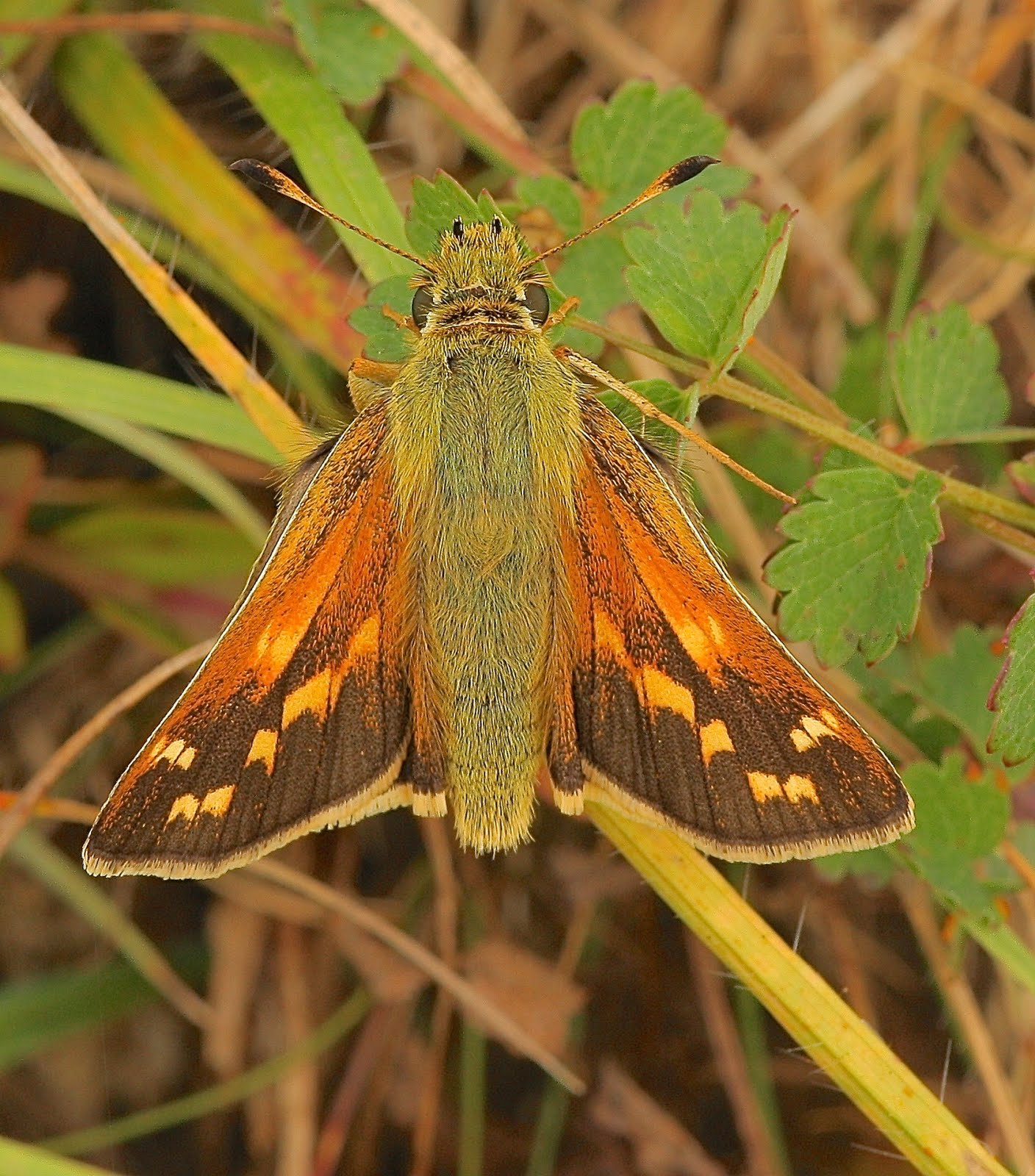
Silver-spotted Skipper

Silver-spotted Skipper's are normally found on south facing chalk hills. Over the last few years their numbers have fallen quite drastically in Surrey and, are now a priority species in the conservation of butterflies of Surrey.

They prefer a habitat of short grass where Sheep's Fescue grows, [where the eggs are laid] and flowers. They visit flowers such as Dwarf Thistle, Scabious, [two of their favourites] Marjoram, and Hard Heads etc. for nectar. On warm summer days, they can be found flying fast and low over the hillside, like out of control helicopters. They fly between the middle of July and early September and, have one brood a year.

The males differ from that of the females apart from the undersides of their wings which are similar. The male have a obvious black sex brand on the top of each forewing, which are absent in the females.


Male Silver-spotted Skipper clearly showing the black sex brands on the forewings.


Female Silver-spotted Skipper showing the upper sides of her forewings, [no sex brands].


Male Silver-spotted Skipper showing the undersides of his wings, [on Marjoram].


Female Silver-spotted Skipper's wing undersides, [on unopened Scabious flower].


The males eyes are also larger than the females.  A pair of Silver-spotted Skippers copulating, [mating] clearly showing the difference in eye size, [female top/male bottom, old and discoloured].


Finally, the tip of the males antenna are orange on top and black on the underside, while the females are black in colour, and this is a very easy way of distinguishing between the sexes when their wings are closed.

Male Silver-spotted Skipper showing his orange tipped [top] and black [bottom] Antenna.


Female Silver-spotted Skipper showing her black tipped antenna.


The ovum [eggs] are laid on  blades  of Sheep's Fescue, [a small species of grass] which are adhered to the grass stems with a gluey substance.


Females have been known to adhere two thin grass stems together in order to lay her egg on safely, [if she feels that one grass stem is not wide enough to  securely hold her ovum].

Two grass stems of Sheep's Fescue that have clearly been adhered together
by a egg laying female Silver-spotted Skipper
They overwinter at this stage, with the tiny larva emerging in the spring.

Tuesday, 2 August 2016

Gatekeeper

Affectionately known as the Hedge Brown, the Gatekeeper is one of England's and Wales' most numerous butterflies, but only found on the south coast, and with a few other scattered sites in Southern Ireland. They fly from early July until late August, they are single brooded. Their favourite flowers are Brambles and Ragwort and Thistles etc. for nectar and love basking in the sun with their wings fully opened.

The males are smaller than the females and have large sex brands on the upper side of each forewing [absent in the female].

Male Gatekeeper showing the two large sex brand on the top of each forewing

Female gatekeeper, larger than the males with no sex brands


The undersides are similar between the sexes but, not quite the same and it is possible to tell the difference between the males and females by the wing undersides if you look closely.


Male Gatekeeper showing the wing undersides


Female Gatekeeper showing her wing undersides, which are sightly different to that of the males


Gatekeepers roost just about anywhere, in trees, shrubs/flowers and down in the grass.

Female Gatekeeper Roosting on Ragwort one of its favourite flowers for feeding on


Monday, 1 August 2016

Buff-tailed Bumblebee

A Buff-tailed Bumblebee feeding on a Thistle flower.


Small Tortoiseshell

The Small Tortoiseshell can be found over most of the British Isles and, is one of our few hibernating butterflies, [six in total]. As a hibernator, the Small Tortoiseshell can live to about nine months. Going down for it's long winter sleep as early late July/early August and waking as early as February/March.  It can be found in most habitats and loves to feed on Bramble flowers and Thistles. Mating takes place overnight in vegetation. They lay their ovum in clusters on the underside of Nettle leaves, they hatch after about 2/3 weeks. The first newly emerging butterflies can be seen early May to June. Coloration of sexes are alike, normally the only way to identify between male and female is by their abdomen, [the females being slightly wider than the males.

Female Small Tortoiseshell

Male Small Tortoiseshell


The underside of a Small Tortoiseshell, male/female are alike